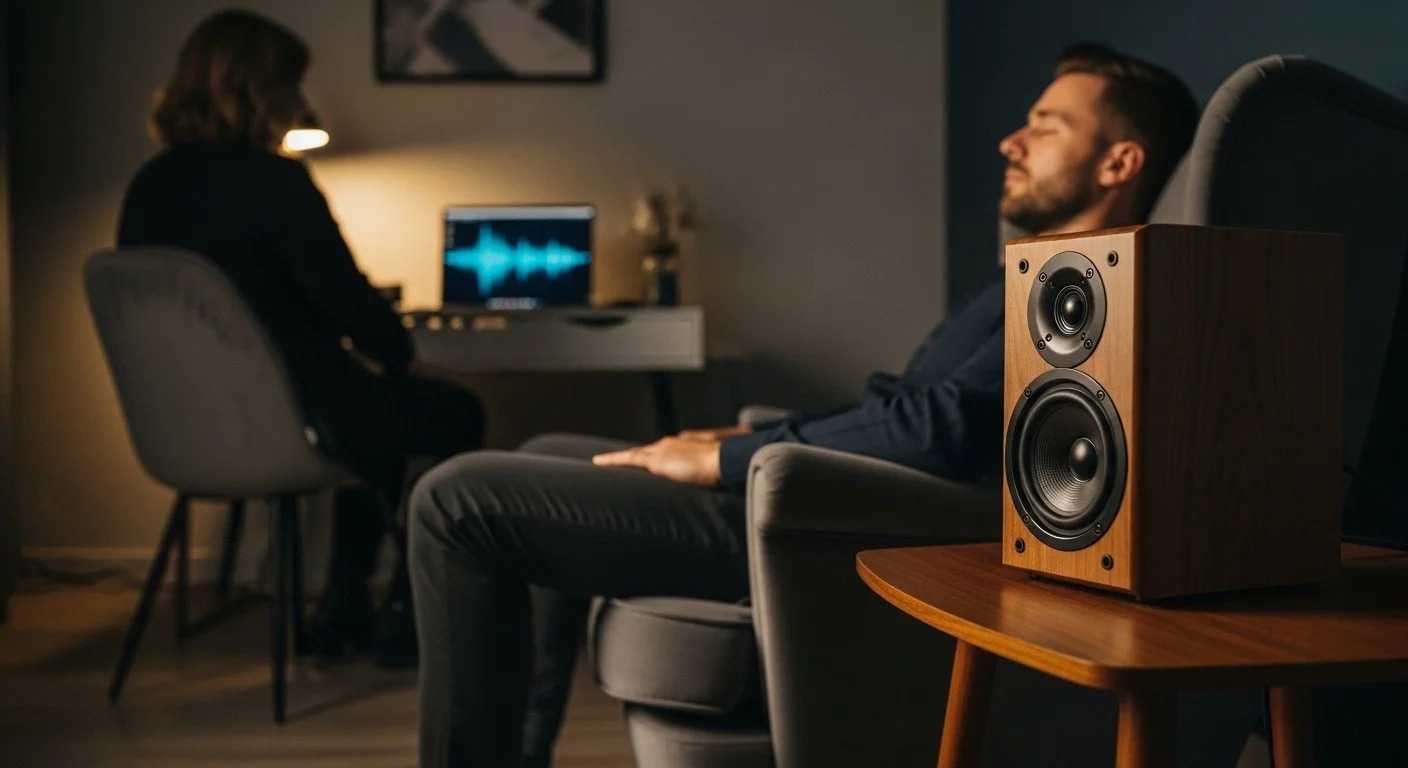
Background Music for Hypnotherapy: Tempo, Texture and Trance Depth
The music you choose for hypnotherapy sessions isn't just atmospheric background—it's actively shaping the depth and quality of the trance state you're guiding your clients into.
Tempo influences how quickly clients descend, sonic texture affects whether they feel safe or exposed, and frequency choices can either support suggestion work or create subtle interference that keeps the critical mind more active than you realise.
Many hypnotherapists discover this through trial and error. They notice that some sessions feel effortless—clients drop quickly, respond beautifully to suggestions, and emerge with clear shifts—while others feel like they're working uphill, with clients hovering near the surface of trance or intellectually "following along" without the deep subconscious engagement that makes the work transformative. Often, the difference comes down to the music.
This isn't about finding the "perfect" track. It's about understanding the technical and neurological principles at play so you can make informed choices that support your specific style of hypnotherapy, whether you're doing direct suggestion work, regression, parts therapy, or Ericksonian indirect approaches.
This guide goes deeper than our foundational post on hypnotherapy music, focusing specifically on the technical elements—tempo, texture, frequency and arc—that experienced hypnotherapists can use to fine-tune their sonic environment and create more consistently deep trance states.
Tempo and the Descent Rate: Matching BPM to Induction Style
Tempo is measured in BPM (beats per minute), and in hypnotherapy contexts, it directly influences how quickly a client's nervous system shifts from alert wakefulness toward trance. Research on music and autonomic nervous system regulation shows that slower tempos correlate with decreased heart rate, slower breathing and increased parasympathetic activation—all physiological markers of trance-conducive states.
But "slower is better" is too simplistic. The ideal tempo depends on your induction style, your client's baseline state, and what phase of the session you're in.
For rapid inductions (confusion, shock, pattern interrupt): Music in the 60–80 BPM range works well because it provides a stable sonic anchor after the moment of disruption. The client's conscious mind has been momentarily bypassed, and the music offers a gentle landing place that supports the shift into trance without forcing it.
For progressive relaxation or body-scan inductions (10–15 minutes): Start in the 70–90 BPM range and gradually let the music slow or become more spacious as the client descends. This mirrors the natural slowing of breath and heart rate during relaxation and gives the nervous system a pace to entrain to.
For deepening and suggestion work (the core therapeutic phase): Drop into the 50–70 BPM range or even slower. At this phase, you want the music to essentially disappear from conscious awareness—slow enough that it's not providing rhythmic structure the client can "track," but still present enough to create a sense of containment.
For regression or parts work (where clients need to access memory or internal dialogue): Very slow or essentially tempo-free music works best—drones, sustained pads, long tones. Anything with a perceptible beat or rhythm can pull clients back toward linear time awareness, which works against the timeless, fluid state needed for deeper process work.
For emergence (bringing clients back to alert awareness): The music can gradually brighten or lift—not necessarily faster in tempo, but with more harmonic movement, slightly more presence in the mid-to-high frequencies, a subtle opening of the sonic space. This supports the return to waking consciousness without jarring them out of the residual trance state.
The key insight: tempo isn't a fixed number for your entire session. It's a variable that should evolve with the arc of your work, supporting each phase rather than staying static throughout.
Sonic Texture: Why “Smooth” Beats “Interesting” Every Time
Sonic texture refers to the feel of the music—whether it's dense or sparse, smooth or jagged, continuous or fragmented, warm or cold. In hypnotherapy, texture matters because it directly influences how safe and held a client feels as they let go of conscious control.
The technical term for what we're after is spectral smoothness—music that has consistent harmonic content without sudden shifts in timbre, instrumentation or sonic density. Think of it like the difference between stroking velvet (smooth, predictable, soothing) versus touching sandpaper (textured, variable, potentially irritating). Both are legitimate sensory experiences, but only one supports the kind of surrender you're inviting in hypnotherapy.
What smooth texture sounds like in practice:
Long, sustained tones (pads, drones) rather than short, percussive sounds
Gradual, seamless transitions between harmonics rather than abrupt key changes
Soft, rounded instrumentation (synthesized strings, warm pads, sub-bass) rather than bright, sharp sounds (bells, metallic percussion, high synth leads)
Consistent sonic density throughout—the "thickness" of the sound stays relatively stable rather than opening into sparse moments and then filling back in
Why texture matters neurologically:
When a client is in trance, their brain's filtering systems are more relaxed. In normal waking consciousness, we're constantly filtering sensory input, deciding what's relevant and what can be ignored. In trance, that filtering softens, which means clients become more sensitive to subtle changes in their environment—including changes in the sonic texture of the music.
A sudden shift in texture—the music becoming sparser, a new instrument entering, a change in tonal quality—can re-engage the monitoring systems of the brain. The client might not consciously notice ("did the music change?"), but their nervous system registers the shift and pulls just a bit of attention back toward external awareness. Over the course of a session, these micro-disruptions accumulate, resulting in lighter trance depth and less receptivity to suggestion.
This is why music designed specifically for hypnotherapy tends to sound quite "boring" to the conscious mind—it's deliberately minimal, unchanging and texturally smooth because that's what allows the subconscious mind to fully disengage from external monitoring.
Frequency Range and the Voice–Music Relationship
One of the most overlooked technical aspects of hypnotherapy music is how the frequency content of the music interacts with the frequency range of your voice. Get this wrong, and your words—no matter how skillfully crafted—will have to compete for sonic space rather than landing cleanly in the client's awareness.
Your voice occupies specific frequencies.
Most human speaking voices have their fundamental frequency in the 85–180 Hz range (lower for men, higher for women), with harmonics and consonant sounds extending up into the 2,000–4,000 Hz range. This is the "mid-range" of the audio spectrum, and it's also where a lot of musical content typically lives—piano, guitar, many synth pads, the body of most ambient music.
If the music is busy in the mid-range, your voice gets masked.
Even if you turn the music down, if it's occupying the same frequencies as your voice, the two will blur together. The client's brain has to work to separate your words from the background, which keeps them in a more alert, analytical state—exactly what you're trying to move them away from.
The solution: music with a “vocal pocket.”
Professional hypnotherapy music is mixed to emphasise low frequencies (sub-bass, deep pads in the 60–150 Hz range) and very soft high frequencies (atmospheric layers above 4,000 Hz), while leaving the 200–2,000 Hz range relatively clear. Your voice sits in that pocket, distinct and intelligible, without having to compete.
How to check if your music has vocal space:
Record a short hypnotic induction over your chosen music track.
Play it back and ask: “Can I hear every word clearly without straining? Does my voice sound muffled or buried? If I close my eyes, does my voice feel like it's in front of the music, or is it mixed into the music?”
If your voice sounds muffled or you have to turn the music extremely low to get clarity, the frequency overlap is the issue. Either choose different music or use EQ in your audio editor to carve out space in the 200–1,000 Hz range.
This is one of the primary reasons practitioners invest in music designed for voice‑led hypnotherapy work—it's pre-mixed with this vocal pocket built in, so you don't have to spend hours tweaking EQ settings.
Harmonic Content: Major, Minor or Modal?
The harmonic character of music—whether it's in a major key (bright, uplifting), minor key (dark, introspective) or modal (ambiguous, neutral)—affects the emotional tone of your session and can either support or work against your therapeutic intention.
Major keys tend to feel optimistic, open, lighter. They can work well for ego-strengthening work, future pacing, or hypnotherapy focused on confidence, motivation or positive expectation. However, they can also feel incongruent if a client is working through grief, trauma or shadow material—the brightness of the music can create an emotional mismatch that prevents full engagement with the difficult material.
Minor keys feel more somber, introspective, emotionally complex. They can support deeper emotional processing, regression work, or grief-focused hypnotherapy. But they can also tip into feeling heavy, sad or even depressive if the client is already in a low mood state, potentially reinforcing the very patterns you're trying to shift.
Modal or harmonically ambiguous music—which avoids clear major/minor tonality—tends to be the most versatile for clinical hypnotherapy. It doesn't impose an emotional direction on the session; instead, it creates a neutral sonic container that allows whatever needs to emerge for that particular client to do so without the music "telling them" how to feel.
Many experienced hypnotherapists prefer modal or drone-based music for exactly this reason: it supports the work without editorialising, letting the client's subconscious lead rather than being shaped by the emotional content of the music.
Predictability and the Critical Factor
One of the primary goals in hypnotherapy is to quiet the critical factor—the analytical, questioning, gate‑keeping function of the conscious mind that evaluates and filters incoming information. When the critical factor is active, suggestions bounce off rather than landing in the subconscious. When it's bypassed or relaxed, suggestions go in more easily and create lasting change.
Music that's unpredictable—with sudden changes, melodic "events," dynamic shifts or rhythmic variation—keeps the critical factor more engaged than you realise. The monitoring part of the brain stays slightly online, tracking the music, anticipating what comes next, processing novelty.
Predictable music, on the other hand, gives the critical factor nothing to do. There's no melody to follow, no harmonic progression to track, no rhythmic pattern to anticipate. The conscious mind gets bored and disengages, which is exactly what you want—it stops monitoring and allows the deeper, receptive parts of the psyche to come forward.
This is why hypnotherapy music often sounds "monotonous" or "uneventful" to someone listening analytically. That monotony is a feature, not a bug. It's designed to be forgotten, to fade into the background so completely that the client stops noticing it—and in that stopping of noticing, the doorway to trance opens wider.
Volume Dynamics and Perceived Safety
Volume in hypnotherapy isn't just about "loud enough to hear, quiet enough not to distract." It's about creating a sense of sonic containment that supports the client's nervous system as they let go of conscious control.
Too loud, and the music becomes a demand on attention—something the client has to manage or tolerate rather than something that holds them. It can also feel overstimulating, particularly for clients with trauma histories or sensory sensitivities, triggering subtle activation rather than supporting rest.
Too quiet, and the music fails to provide the container function you're using it for. Environmental sounds (traffic, footsteps, HVAC hum) become more noticeable, the silence between your words can feel exposing or uncomfortable, and the client may struggle to fully let go because there's not enough ambient "safety signal" in the space.
The sweet spot is just at the threshold of awareness—loud enough that the client notices it when they first lie down and settle in, but quiet enough that once they drop into trance, it fades to the edge of perception. Many hypnotherapists describe this as "music you feel more than hear."
Volume should also shift slightly across the session. During the active induction and deepening phases, when you're speaking frequently, the music can be on the quieter end. During suggestion work or silent deepening (where you leave space for the client to go deeper without verbal guidance), you can allow the music to be slightly more present, filling the silence without overwhelming it. During emergence, pull it back down so your voice is clearly dominant as you bring them back to alert awareness.
This kind of subtle volume automation requires either live adjustment (if you're in the room with a volume knob) or pre-recorded tracks where volume shifts are built into the composition—another reason practitioners often use purpose‑built hypnotherapy music rather than trying to adapt consumer ambient tracks.
The Arc of a Session: Musical Structure for Hypnotic Journey
Just as your verbal guidance follows an arc—induction, deepening, therapeutic work, re‑alerting—your music should mirror that structure, even if the shifts are subtle.
Induction phase (0–10 minutes): Music can be slightly more present here, with a gentle downward energetic pull. This is where you're inviting the shift from waking consciousness into trance, and the music can support that by offering a sense of "going down" or "going inward"—not through dramatic dynamics, but through subtle slowing, softening, or harmonic descent.
Deepening phase (10–20 minutes): The music should become sparser, slower, more drone-like. You're guiding the client deeper, and the music needs to get out of the way even more, providing just enough presence to prevent the space from feeling empty or unsettling.
Therapeutic work (20–40 minutes): This is when the music should be most minimal and predictable. Whether you're doing suggestion work, regression, parts dialogue, or somatic processing, the music's only job is to hold the container—to create a baseline of safety and continuity while the real work happens between you, the client, and their subconscious.
Emergence (40–50 minutes): The music can subtly brighten or open—not louder, but with slightly more harmonic movement, a bit more presence in the higher frequencies, a sense of "returning to the surface." This supports the client's nervous system as it shifts back toward waking awareness without jolting them out prematurely.
Many hypnotherapists use single long-form tracks (45–60 minutes) that are composed with this arc already built in, so the music naturally supports the session structure without requiring manual transitions or changes. If you want help turning these theoretical choices into concrete track selections, it can be useful to think in practical durations first and build around the five core track lengths every meditation teacher should have so your trance arcs are always fully covered.
When to Use Frequency-Specific Music in Hypnotherapy
Some hypnotherapists incorporate theta or delta frequency-based music to support brainwave entrainment—the idea being that music built around specific frequencies (4–8 Hz for theta, 0.5–4 Hz for delta) can help guide the brain toward the states associated with deep trance and subconscious receptivity.
When this works well:
Clients who are highly analytical or struggle to "let go" may benefit from theta-range music during induction and deepening, as it offers neurological support for shifting out of beta (alert, thinking) states.
Sleep-focused hypnotherapy or bedtime recordings, where delta frequencies support the transition into actual sleep rather than sustained trance.
Clients who are familiar with and responsive to brainwave entrainment from their own meditation practice and report that it helps them access deeper states more quickly.
If you want a deeper dive into using frequency work safely with clients, we unpack the neuroscience, risks and practical applications in Using Theta Waves and Binaural Beats Safely in Client Work and Delta Waves and Deep Sleep: How Music Supports Your Client’s Nervous System.
When to skip it:
Clients who find frequency-specific music uncomfortable, clinical or "too scientific"—some people prefer more organic, musical soundscapes.
When you're already getting excellent trance depth with neutral ambient music—there's no need to add another variable if your current approach is working.
For very short sessions (under 20 minutes)—brainwave entrainment takes time, and there's little benefit if the session ends before entrainment has meaningfully occurred.
As always, individual responsiveness varies. Some clients are highly sensitive to frequency work and report much deeper trance states; others notice little to no difference.
And as soon as you start recording these sessions for clients to replay, the music stops being "just background" and becomes part of a product, so it’s worth running through Music Licensing for Meditation Teachers and Therapists: Everything You Need to Know to make sure your hypnotherapy catalogue is legally solid.
FAQ: Technical Aspects of Hypnotherapy Music
What tempo should hypnotherapy music be?
It varies by phase: roughly 70–90 BPM for progressive inductions, 50–70 BPM for deepening and suggestion work, and very slow or tempo-free for regression/parts work. The music should generally slow as the session deepens.
Why does “smooth” texture matter more than melodic beauty?
Smooth, unchanging sonic texture allows the critical factor to disengage. Melodic complexity or textural shifts keep the monitoring systems of the brain more active, preventing full surrender to trance.
What's a “vocal pocket” and why does it matter?
A vocal pocket is the mid-range frequency space (around 200–2,000 Hz) left relatively clear in the music so your voice can sit cleanly on top without competing. If the music is busy in that range, your words get masked and clients have to work harder to hear you, keeping them in a more alert state.
Should hypnotherapy music be in major or minor key?
Modal or harmonically ambiguous music is most versatile because it doesn't impose an emotional direction. Major keys work for ego-strengthening, minor for emotional processing, but neutral/modal allows the client's subconscious to lead.
How loud should the music be during suggestion work?
Very quiet—just at the threshold of awareness. During induction and deepening it can be slightly more present, but during core therapeutic work it should fade almost to the edge of perception.
Do binaural beats or theta frequencies actually deepen trance?
For some clients, yes—research shows modest but measurable effects on trance depth and brainwave patterns. But individual response varies. Use them if your client is open and responsive; skip them if standard ambient music is already working well.
Can we use the same music for every hypnotherapy session?
You can, and some practitioners do to create consistency. But having a small library (for example, induction‑focused, regression‑focused, sleep‑focused) allows you to match music to session type and client needs more precisely.